

SUMMARY
A national visibility score tells a multi-location business almost nothing. Obsero Local scores visibility at town and postcode level, against the competitors who actually operate in that location. Local AI answers have two components, a map built from structured business records and a text answer built from web pages, and citation patterns shift by platform in ways that matter more at local level.

A national visibility score tells a multi-location business almost nothing.
We see it constantly. A brand scores 25 out of 100 across its category, and that single number gets treated as the state of play. But a brand trading in eight towns doesn't have one visibility problem. It has eight, and they rarely look the same.
We tested this on a UK business with four locations. One town returned 90% visibility on its strongest prompt. Another returned zero on every prompt we ran. Same brand, same week, same questions. The national score described neither.
That gap is why we built Obsero Local.
What it does
Obsero Local scores your visibility at town and postcode level, against the competitors who actually operate in that location. Not your national competitor set. The businesses a customer in that town would realistically be shown instead of you.
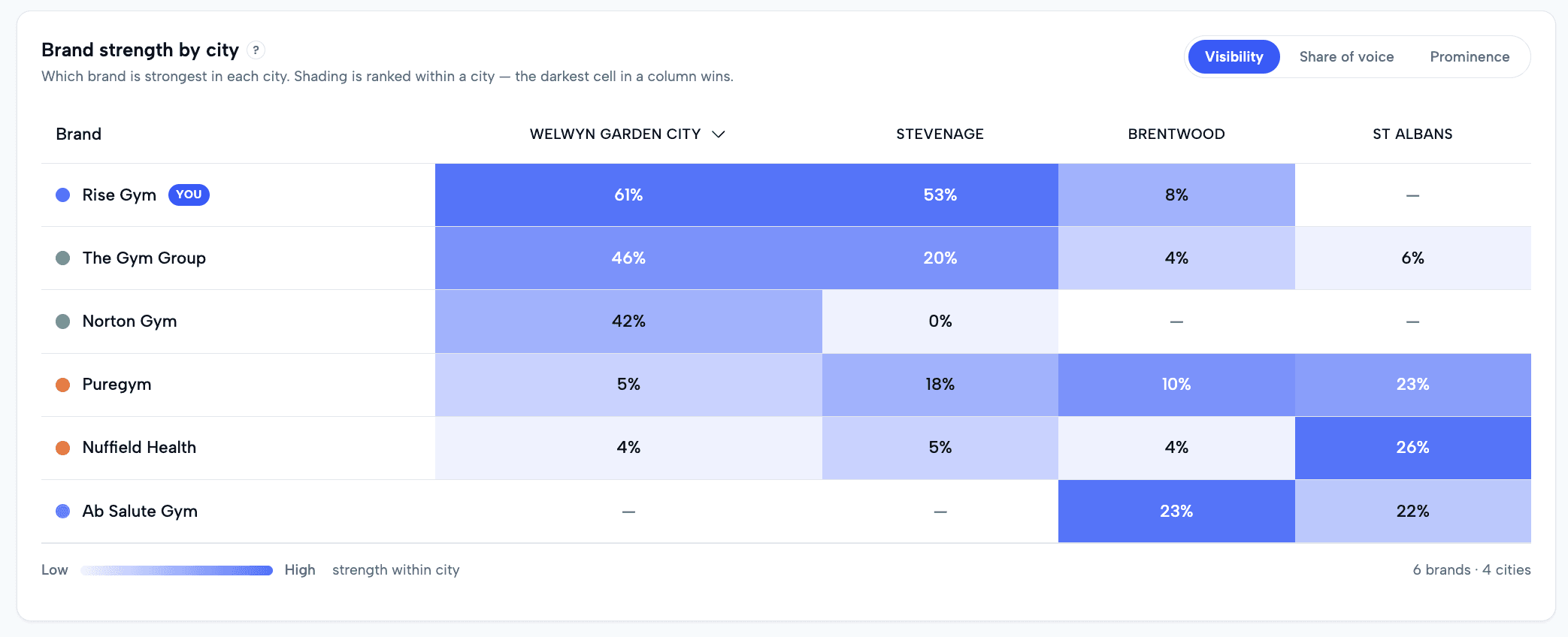
You get a view of which locations are winning, which are invisible, and what's driving the difference. Because the reasons vary. One site might be losing on commercial prompts because pricing isn't published anywhere a model can read. Another might have no location page at all. A third might be positioned as a general provider when customers are asking for a specialism.
Those are three different jobs. A national score gives you none of them.
Why local is different
Two things make local AI search behave unlike national.
The first is that an AI answer for a local query has two components. A map, filled with structured business records, and a text answer built from web pages. They draw on different sources. You can appear in one and be absent from the other, and fixing one doesn't fix the other.
The second is that citation patterns shift by platform in ways that matter more at local level. On Google's own surfaces, the most cited source for local queries often isn't a website at all. It's the Google Business Profile. On other platforms, aggregators and directories dominate. Your own site can be the top cited domain on one platform and outside the top five on another.
What you get
Obsero Local gives you five things a national view can't.
Visibility, share of voice and position by location. Every town you operate in, side by side, so you can see which locations are carrying the brand and which are invisible.
Postcode-level competitor sets. Not your national rivals. The businesses a customer in that specific location would realistically be shown instead of you.
Local Competitor Threat. The competitor beating you across the most locations, and by how much. One number that tells you who to worry about.
Expansion assessment. Before you commit to a new location, see who already owns it in AI answers and how contested it is.
Citations by location. Which sources are driving the answers in each town. They vary far more than most brands expect.
All of it tracked across ChatGPT, Gemini, Google AI Mode, AI Overviews, Perplexity, Copilot and Claude.
Who it's for
Any business trading in more than one location. Franchise networks, owner-operator chains, multi-site independents, agencies managing local clients. A four-site gym group has the same problem as a twelve-branch estate agency.
If you have locations, you have a per-location visibility position. Obsero Local is how you see it.
Growth through intelligence
Capture your brand’s historic visibility, recommendation and sentiment data from AI Search in one intuitive platform
Table of Contents