
Back to Insight
Product
Who's advertising against your brand in ChatGPT?

Andy Francos
SUMMARY
Ads have been running inside ChatGPT answers since February. Obsero now shows you how often your prompts return a paid placement, and exactly who is buying them.


Ads have been running inside ChatGPT answers since February. If you sell anything, there is a reasonable chance a competitor is already paying to appear underneath the answer you spent two years earning.
Until now there has been no way to check. Obsero now shows you.
Ad coverage is now live in Obsero, and it tells you how often your tracked prompts return a paid placement, and exactly who is buying them.
Why we built a ChatGPT adsuite
Ads in ChatGPT is huge, controversial and are a growth lever for marketers.
For OpenAI they are the business model. For brands they are a new channel with almost nobody in it yet. Those two things being true at the same time is rare, and it does not last long.
Think back to paid search in 2002. A handful of advertisers, cheap inventory, no playbook and an enormous head start to anyone who moved early. That is roughly where ChatGPT ads sit today. The minimum spend has gone from $250,000 to $15 in a couple of months. Nine countries are live and Europe landed in August, and the formats are being updated constantly.
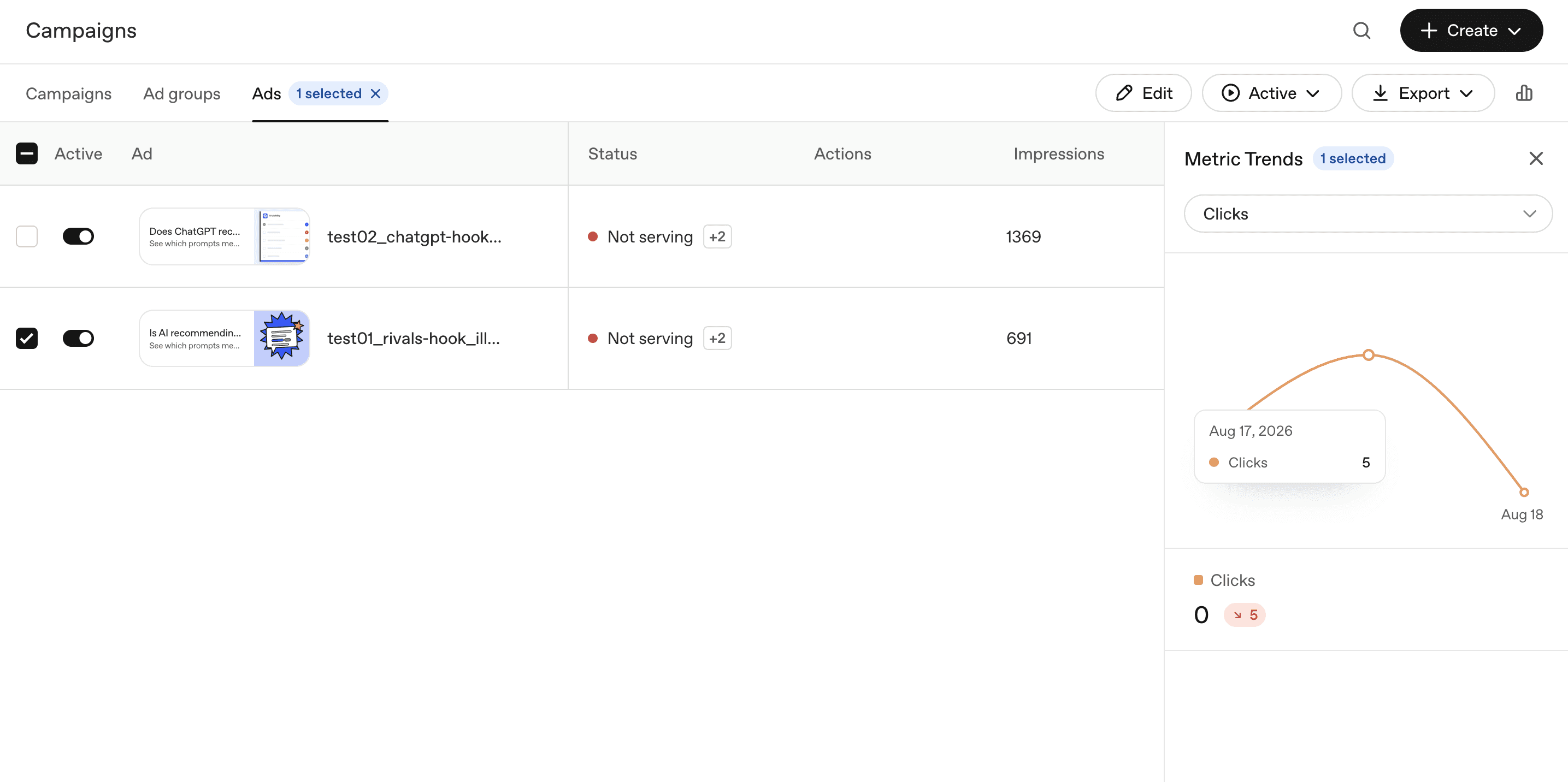
Below is an extract from Obsero's OpenAI's Ad Manager account, showing the interface and the two ads (now paused) run.
The brands that win this will be the ones who understood the surface before everyone else turned up.
So we built the ads features that lets you see it.
Obsero shows you every advertiser appearing across your prompt set, the share of the category they hold, the creative they are running and the exact prompts that triggered it, which is a level of competitive intelligence you would not normally get on a channel this young.
We can show you this because we capture real front-end answers rather than calling an API. We see what your customer sees, ads included.
Audience tools are nonexistent and OpenAI does not give advertisers prompt-level reporting, even for their own campaigns. Buyers are calling it the ChatGPT Ads blind spot. So you now have a view of this channel that the people buying it do not.
What we found when we pointed it at Levi’s
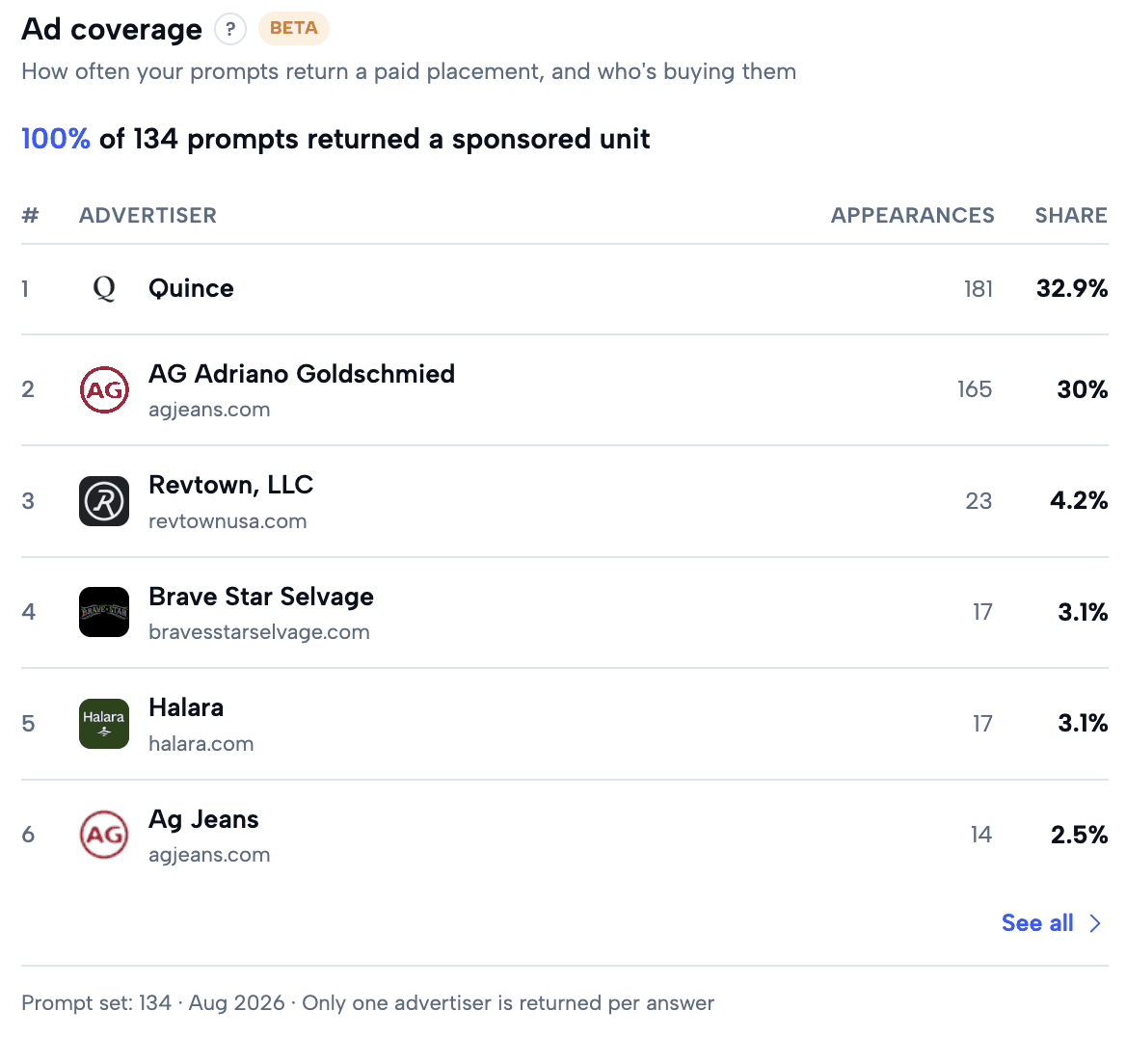
We ran it across our Levi’s prompt set. 134 prompts, tracked weekly, the kind of questions a person actually asks before buying jeans.
Every single prompt returned a sponsored unit. All 134.
For context, published third-party studies put ad coverage at around 26% of commercial prompts. Apparel is the densest category going, retail and grocery accounted for 44% of all ChatGPT ad impressions in the first weeks of the pilot, so a high number is expected. 100% is still higher than anything published.
Part of that is what we measure. Roughly two thirds of ChatGPT ads appear at the second prompt or later, so a single-turn scrape misses them. We track the conversation, not the opening question.
Across those 134 prompts we captured 550 sponsored units. The single biggest advertiser, Quince, held 33% of them.
What you can actually do with it
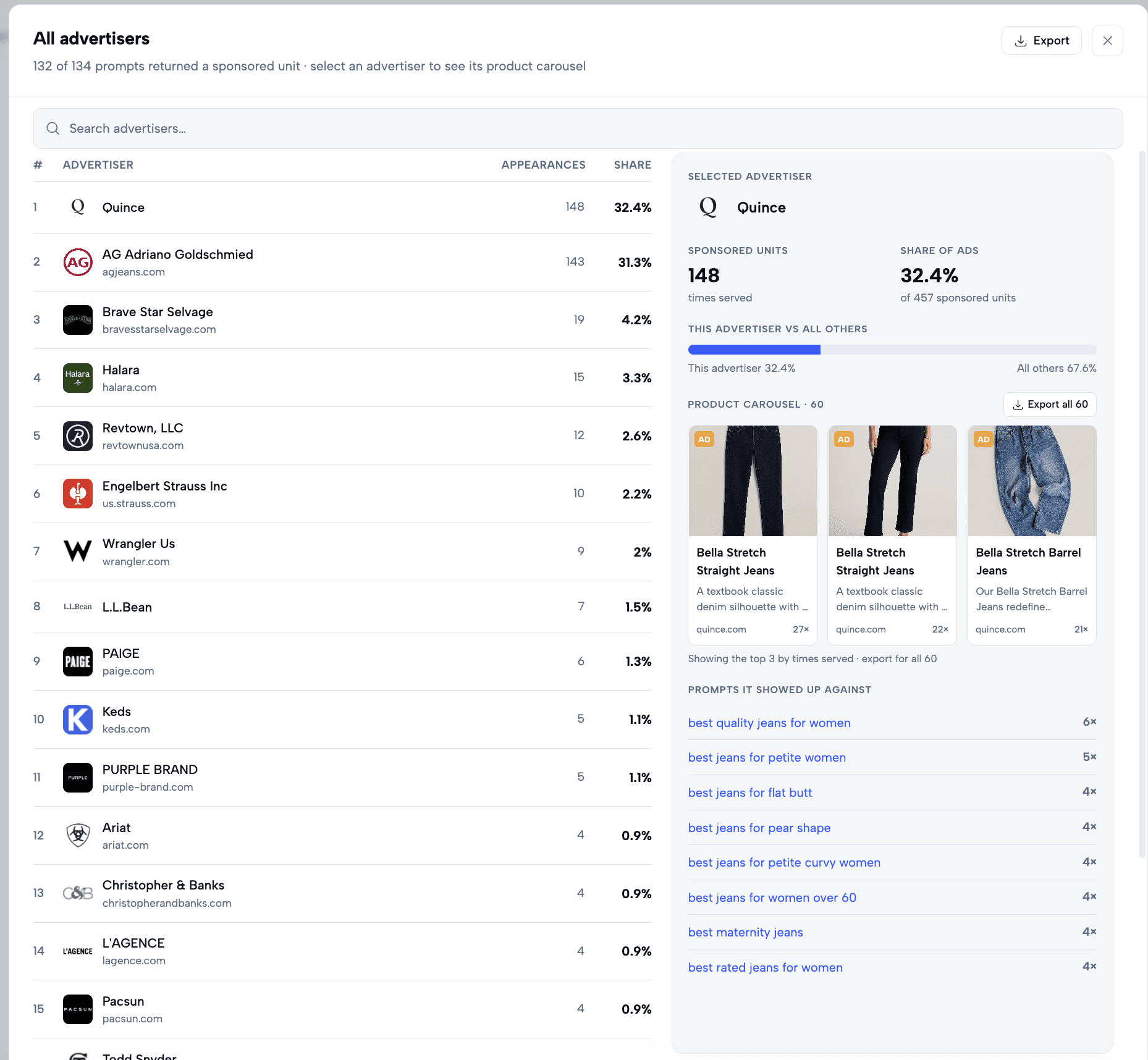
Open Obsero's Ad coverage and you get the list of every advertiser appearing across your prompt set, ranked by share.
Click one and you see how many sponsored units they ran, what share of the category they hold, and the actual creative. Product images, headlines, body copy, as it appeared.
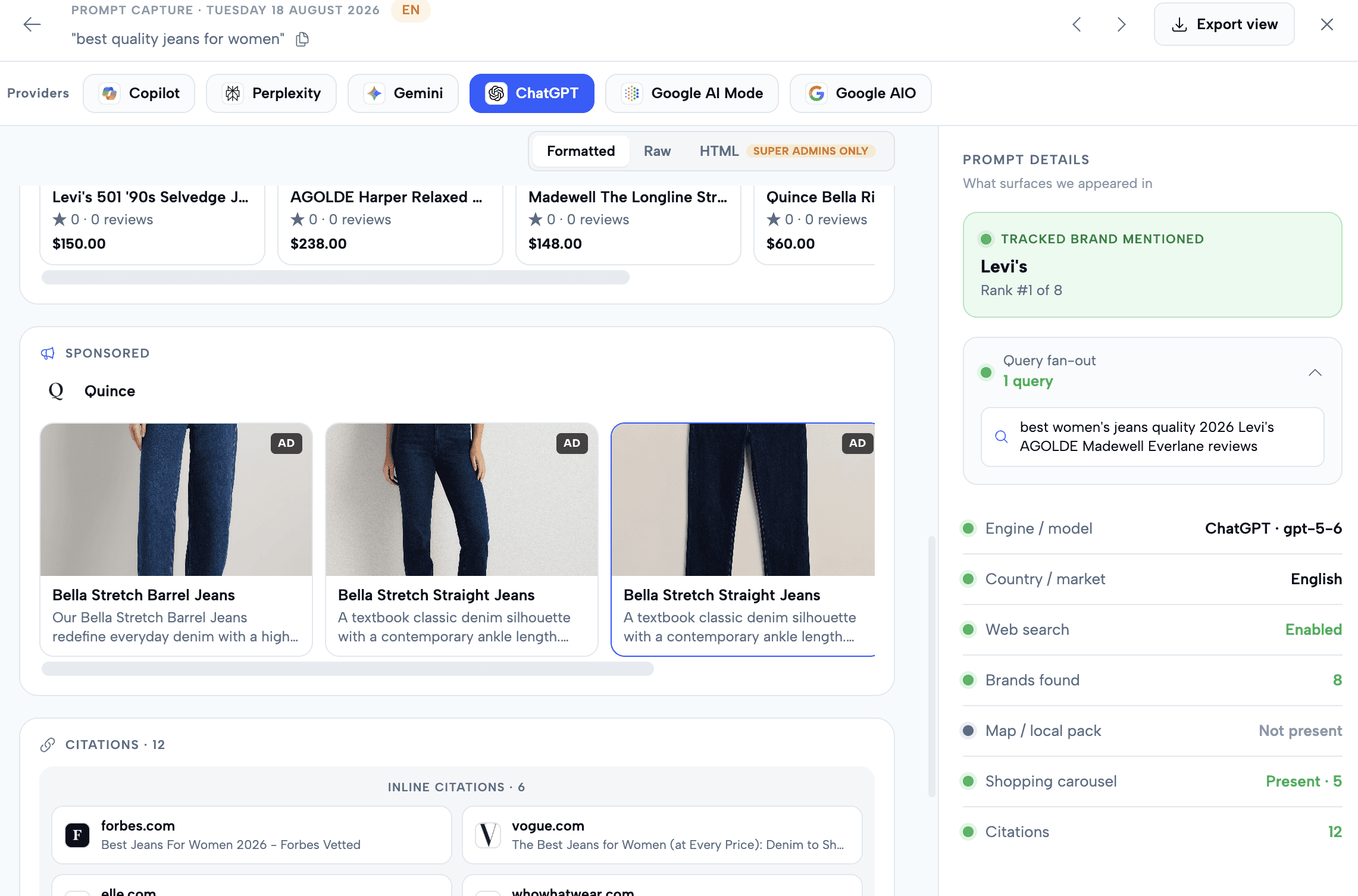
Click through to the prompts. For Quince, one of them is “best quality jeans for women”. Scroll and you see the ad unit rendered as a user would have seen it at that moment.
Three things fall out of that, and they are all things a brand team can act on this week.
You find out who is bidding on your category, which is not always the same as the competitive set you think you have. These are the brands actually paying to sit under the answer.
You see the creative. Every headline, every image, every offer your competitors are testing. That is a briefing document for your own campaigns, and you did not have to buy a single impression to get it.
You see which prompts carry paid pressure and which don’t. A prompt with no advertiser on it is one you can still win on merit. A prompt with four is one where earned visibility is now competing with a budget.
The size of OpenAI’s bet
OpenAI's internal forecast, leaked in April, puts advertising at $2.4bn in 2026, around $11bn in 2027 and $102bn by 2030. That last number is 36% of the company's projected total revenue. A year earlier the same plan had 2027 at $5.9bn. They roughly doubled it in twelve months.
Actual performance is behind that, but moving fast. Ads were at roughly $100m annualised in March, still roughly $100m in May, then about $1bn by mid-August. OpenAI's enterprise CMO said this week it has grown more than 25% since the start of August alone.
There is a well-shared story from July saying OpenAI is on track to miss its own ad forecast by 90%. Worth knowing that analysis was written against the $100m figure. Nobody has revisited it since the $1bn number landed.
Either way, the direction is not in question. Paid placement is now a permanent feature of the surface where your customers ask what to buy. Measuring your earned visibility and ignoring the paid layer underneath it is measuring half the answer.
What’s actually happened with ChatGPT ads
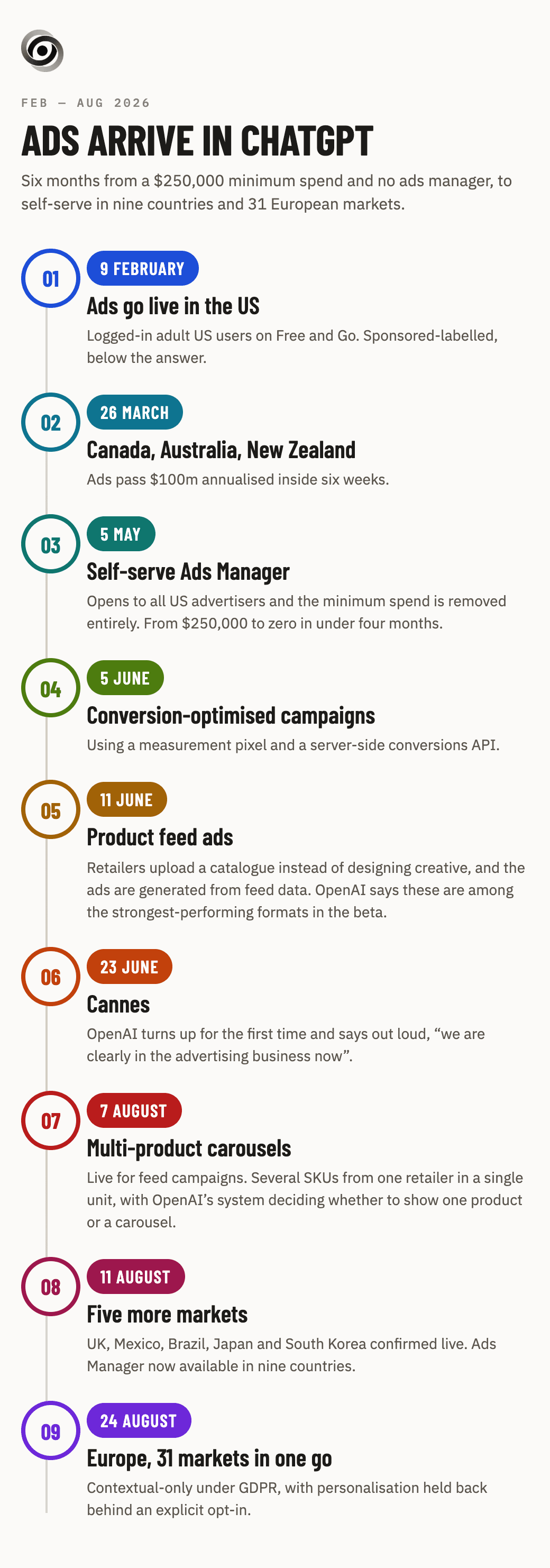
If you have not been following this closely, here is the short version.
The timeline
Targeting barely exists
This is the part most SEOs get wrong, because they assume it works like Google.
There is no keyword targeting, and no demographic or interest targeting either. What you get instead is a feature called context hints, which is a free-text description at ad group level of the conversations and topics where your product might be relevant. OpenAI’s own wording is that hints “guide matching but are not exact-match targeting rules” and do not guarantee delivery.
Beyond that you get geography, custom audiences, audience exclusions and negative keywords, and that is genuinely all of it.
So the matching is being done by a model reading the conversation, your landing page and your ad copy. Which means the same thing that decides whether you get cited organically is deciding whether your ad is relevant. Content quality is now a paid media input. That is genuinely new and almost nobody is treating it that way.
And the honest limits
Only one advertiser is returned per response today, so this is not a full competitive ad intelligence picture in the way you would get from Google. OpenAI has been testing multi-advertiser placements since June, and when those roll out properly this data gets considerably richer.
The data is country-level. There is no city-level signal in the payload, so local ad targeting is not something anyone can report on yet.
Tracking ChatGPT ads over time
Ad coverage tells you which of your topics are contested today. The next layer is contested over time, so you can watch a category heat up before your competitors have finished budgeting for it.
Alerts are coming with it. A new advertiser appearing on your prompts will reach you by email rather than waiting for you to go and look.
It is live now in the E-commerce report.
Someone is already paying to appear underneath your category's answers. Come and see who.
Common questions
How much do ChatGPT ads cost?
Where do ChatGPT ads show up?
Why does ChatGPT suddenly have ads?
What does the ChatGPT ads manager do?
Can you advertise on ChatGPT?
How can I track conversions for ChatGPT ads?
How do I stop ads on ChatGPT?
Is AI advertising illegal?
Growth through intelligence
Capture your brand’s historic visibility, recommendation and sentiment data from AI Search in one intuitive platform