

SUMMARY
ChatGPT now has 900 million weekly active users and processes 2.5 billion prompts a day. According to McKinsey, around half of US consumers now intentionally turn to AI-powered search when researching purchases, and $750 billion in US revenue is projected to flow through AI-powered search by 2028. This guide sets out what actually moves the needle on ChatGPT visibility - grounded in real implementation data and visibility tracking across multiple industries.
Understanding ChatGPT's content retrieval and citation mechanisms
ChatGPT does not work like traditional search engines. It draws on two distinct sources: training data (the massive corpus of text it was trained on, with a knowledge cut-off) and real-time web retrieval via Retrieval-Augmented Generation (RAG), where it searches the web for current information and synthesises results into an answer.
When a user types a prompt, ChatGPT decides whether it can answer from training data alone or needs to go to the web. For timely, specific, or commercial queries, it conducts a query fan-out: multiple sub-queries run simultaneously via its search infrastructure. It then selects 10 to 20 candidate sources, synthesises their content, and presents a response. Your goal is to be among those selected candidates.
ChatGPT originally relied heavily on Bing's index, but as of 2026 it also leverages Google's index and has its own crawling infrastructure (GPTBot, OAI-SearchBot, ChatGPT-User). According to OpenAI's technical documentation, this means your Bing optimisation matters more than most brands realise, but Google performance still underpins much of what ChatGPT retrieves.
The three types of ChatGPT responses and visibility implications
Understanding these response types is essential because your strategy differs depending on which type your target queries trigger.
Training data responses: General knowledge questions where the answer is already baked into the model. Think encyclopaedia-level queries. Your content influenced this during training, but you cannot change it now until the next training cycle. Influence here is a long game played through sustained brand authority and content volume.
RAG (Retrieval-Augmented Generation) responses:Timely or specific questions where ChatGPT searches the web, retrieves sources, and synthesises an answer. This is where your on-site content, citations, and third-party mentions directly influence whether your brand appears. Most of the visibility you can actually influence sits here.
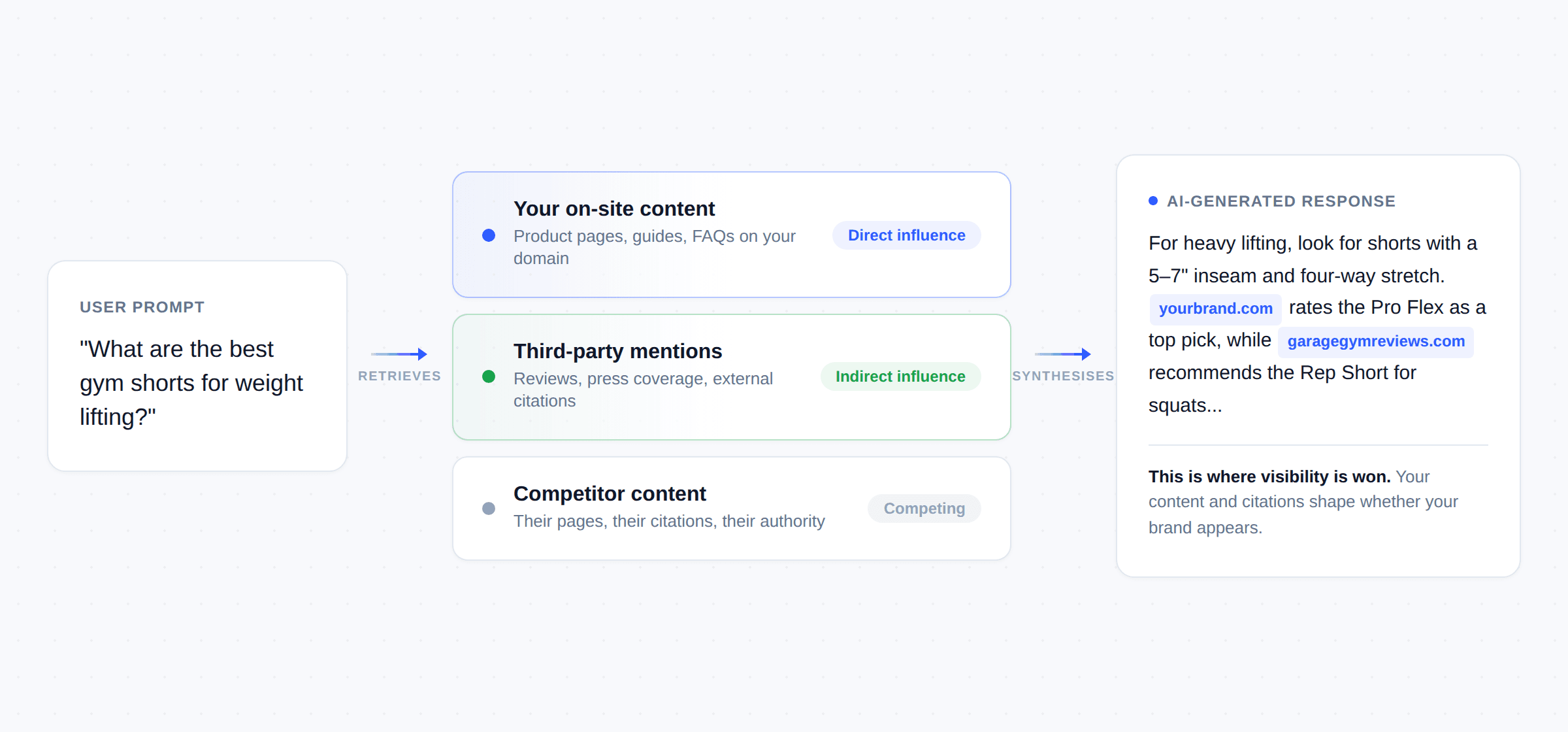
According to research from Princeton University, brands appearing in RAG responses benefit from strong search engine performance, diverse citation sources, and machine-readable content optimised for both Google and Bing. Content with quantitative data significantly outperforms purely qualitative content in AI citations.
Mixture of experts and deep research responses. Complex, multi-faceted queries that trigger reasoning rounds across multiple neural networks and web sources. These pull from many sites across multiple reasoning steps. Depth and breadth of content matters most here.
If your schema triggers a rich result on Google or Bing, and the query is one where ChatGPT uses RAG to retrieve web results, that rich result can influence how you are perceived in the AI response. This is the nuanced truth behind the schema debate — it matters, but only in the RAG context, not for training data responses.
Create comprehensive, question-answering content that addresses user intent
These strategies are ordered by impact based on tracking data from over 60 brands across multiple sectors as of Q1 2026. This is the foundation. If your brand does not provide answers to the questions being asked, no amount of technical optimisation will help.
Map the questions your customers actually ask. Use tools like AlsoAsked, AnswerThePublic, and Google's People Also Ask feature to find conversational queries that map directly to ChatGPT prompts. Track a selection of these in your visibility platform.
Audit your coverage. For every key commercial prompt in your category, does your website have content that directly answers it? If not, that is your gap.
Write for the full customer journey. Google Search Console data reveals real user questions spanning the full journey — from initial research through to feature-level comparisons. Your content needs to cover the entire arc, not just bottom-of-funnel commercial pages.
Ground your content in facts and data. Extensive data points and factual grounding are favoured by AI models. First-party data, proprietary research, and specific numbers give your content an edge over generic commentary. Content with quantitative data significantly outperforms purely qualitative content in AI citations.
Use clear, descriptive headings. Structure your content with keyword-rich H2 and H3 headings that directly state the topic or question being answered. Avoid vague headings like "Overview" or "Introduction" — instead use "How ChatGPT decides which sources to cite" or "The role of Bing indexation in AI visibility."
Provide direct, concise answers at the beginning of sections. AI models favour content that answers questions clearly in the first 2-3 sentences of each section, then elaborates with supporting detail.
Build third-party citations and ensure technical foundations
This is the lever most brands underestimate. In AI search, unlinked mentions matter more than backlinks.
Identify which sources ChatGPT already cites in your category. Track which domains appear as citations when your target prompts are asked. These are the publications and aggregators you need to be present on.
Invest in brand inclusion on high-citation sources. Think of this as modern PR, not link building. Key aggregators, review sites, and industry publications that ChatGPT consistently cites are where your brand needs to appear. This includes editorial placement and authentic participation on trusted platforms.
Diversify your citation sources. Brands whose categories rely heavily on homepage citations rather than diverse site content have limited narrative control. Competitors who pull from multiple internal pages covering specific topics get better narrative and prominence in AI answers.
Monitor and engage on forums and community platforms. User-generated content on platforms like Reddit, Quora, and industry-specific forums significantly influences AI narratives. According to research from affiliate tracking platforms, 60% of brokerage content is directly accessed by AI bots. Engaging authentically in relevant communities can shape how your brand is discussed.
Serve critical content as static HTML. ChatGPT's crawler does not always render JavaScript. If your content is hidden behind JS rendering, it may not see it at all. Serve critical content as static HTML or use server-side rendering.
Check your server speed and status codes. 499 status codes and slow page loads mean AI crawlers may abandon your page before reading it. This is not just a Core Web Vital issue — it directly affects whether your content gets retrieved.
Make your content crawlable across platforms. Your content needs to be discoverable and indexable on Google, Bing, and by ChatGPT's own crawler (GPTBot, OAI-SearchBot, ChatGPT-User). Review your robots.txt for all three. Ensure none of these user agents are blocked.
Consider OpenAI's product feed for e-commerce. There is a separate product feed for OpenAI's vendor market. This has historically been an ad-space concern, but SEOs and content strategists now need to manage it as well.
Implement schema as part of strong technical foundations, not as an AI visibility lever
Schema's role in AI visibility has been debated heavily over the past 18 months. Our position has always been measured - schema is good practice, but it was never going to be the thing that suddenly made you visible in AI search. Two studies in May 2026 confirmed and sharpened that view.
Two studies are worth knowing about:
Ahrefs tracked 1,885 pages that added JSON-LD between August 2025 and March 2026, matched them against 4,000 control pages, and measured citation changes. Adding schema produced no meaningful uplift on any platform: AI Mode +2.4%, ChatGPT +2.2% (both statistically indistinguishable from zero), and AI Overviews actually declined 4.6%. The study pooled all schema types together, so it is possible some types help more than others.
A searchVIU experiment from December 2025 tested whether ChatGPT, Claude, Perplexity, Gemini, and Google AI Mode used schema markup at the point of direct fetch - when a chatbot retrieves your page in real time. None of them did. Every system extracted only visible HTML. JSON-LD was ignored at this stage. The study is explicit that schema may still be used earlier in the pipeline - during training, indexing, or search-index lookup — and Google's crawlers do extract it. The finding is narrower than the headlines suggest: schema is not the live-retrieval signal people thought it was, but it still does work upstream.
Alongside this, Google deprecated FAQ rich results in May 2026, completing a three-year wind-down. Search Console reporting ends in June, API support ends in August. FAQ schema is now neither a rich-result trigger in Google nor a real-time retrieval signal for AI systems. You can read about the slow death of FAQ schema.
Net of all this, the picture is consistent with what we have always said. Schema is not the lever that gets you cited in AI answers. But it still has indirect value through Google. Here is the honest breakdown.
Schema is ignored at real-time retrieval. When ChatGPT, Claude, Perplexity, Gemini or AI Mode fetch your page live, none of them parse JSON-LD. They extract visible HTML. That is the finding that matters most for AI citation in the moment.
Schema still works indirectly through Google. Article, Organisation, LocalBusiness and Product schema are read by Google for indexing, knowledge graph entity recognition, and the rich results that still exist (Product, Review, Recipe, Event, Video, Breadcrumb, and a few others). AI systems that retrieve via Google's index benefit from anything that strengthens your Google presence. The path is schema → stronger Google understanding → AI retrieval via Google. It is not schema → AI citation.
FAQ schema no longer produces rich results in Google. FAQPage remains a valid Schema.org type and the markup will not cause problems, but it no longer produces visible Google results and AI systems ignore it at retrieval. Do not add it expecting either rich results or an AI citation uplift.
The signal AI systems actually use is visible HTML. Clear headings, direct answers in the first two to three sentences, and structured question-and-answer content in the page body itself are what get parsed and cited. Structure your visible content as if you were writing FAQ schema, but on the page.
Organisation schema helps with entity disambiguation. Comprehensive Organisation schema with sameAs links to your LinkedIn, Crunchbase, Wikipedia and other authoritative profiles helps Google understand that these all refer to the same entity. AI systems that use Google’s knowledge graph at the training or indexing stage benefit from this, even though they ignore the markup at retrieval.
Schema may still help pages not yet in the AI consideration set. The Ahrefs study only covered pages already getting heavy AI citations. For pages that have never been retrieved, schema could still play a role in helping AI systems crawl, parse, and discover them in the first place. That hypothesis has not yet been tested at scale.
Test your schema implementation. Use Google's Rich Results Test and the Schema Markup Validator to make sure what you do implement is correct.
Summary: keep your schema if you have it - it is doing useful indirect work through Google's index and knowledge graph. But it was never the lever that would get you cited in AI answers, and recent evidence confirms that. The things that actually move AI visibility are visible HTML structure, third-party citations, and being present where AI systems look.
Create content formats that AI models prefer to cite
Not all content types get cited equally. As of H1 2026, certain formats significantly outperform others.
Comprehensive guides (2,000+ words) that thoroughly cover a topic get cited more frequently than brief overviews.
Data-driven research and original studies establish your brand as a primary source.
Comparison and evaluation content with specific criteria and scoring methodologies perform well.
How-to guides with step-by-step instructions provide the structured information AI models need.
Statistical compilations become go-to resources for AI models seeking quantitative support.
Manage brand sentiment and narrative in AI responses
Visibility alone is not enough. What ChatGPT says about you matters just as much as whether it mentions you.
Track sentiment across AI platforms. Positive, neutral, and negative narratives affect whether ChatGPT recommends your brand or warns users away from it. Use AI visibility tracking platforms to monitor sentiment over time.
Address negative themes at source. Sentiment analysis has revealed issues like claims handling delays and pricing concerns that directly impact AI recommendations. Fix the underlying problems, and the narrative follows.
Trust is a repetition game. AI systems behave like neural memory. The more often your brand is cited across trusted sources for a topic, the higher its trust score, and the more likely it is to be cited again. Once you earn that score, it tends to stick until a competitor's score overtakes it. The implication for brand-builders is clear. One-off placements rarely shift the narrative. Consistent, repeated presence in the places AI systems trust is what does.
Publish authoritative thought leadership. Establish your brand as a category expert through white papers, research reports, and expert commentary. These assets are frequently cited by AI models when synthesising answers. Cite primary research sources and include author credentials.
Respond professionally to reviews and public feedback. AI models can pick up sentiment from review platforms and social media. Professional, helpful responses to criticism demonstrate customer service commitment and can positively influence overall brand perception.
Track and measure your ChatGPT visibility over time
You cannot improve what you do not measure. Establishing a baseline and tracking performance is essential.
Conduct a 15-minute baseline visibility audit. For 10-15 key prompts your customers use, ask ChatGPT for answers and record: whether your brand is mentioned, position in the response (early vs. late), sentiment of the mention (positive, neutral, negative), whether you are cited as a source, and which competitors appear alongside you.
Use AI visibility tracking platforms. Several platforms now specialise in monitoring brand mentions across AI models. These tools track mention frequency, sentiment, citation rate, and competitive positioning over time.
Monitor referral traffic from ChatGPT. Check your analytics for referrals from chat.openai.com and related domains. While not all ChatGPT traffic will show clear referral data, tracking this metric provides insight into whether visibility is translating to traffic.
Track rankings on both Google and Bing. Since ChatGPT draws from both indexes, monitor your search rankings on both platforms for queries related to your target ChatGPT prompts. Correlation between search rankings and AI visibility is strong.
Document changes to your content and their impact. When you implement optimisations (schema, FAQ sections, content expansions), note the date and monitor how ChatGPT's responses evolve over the following 4-8 weeks.
Create a regular reporting cadence. Review your ChatGPT visibility metrics monthly or quarterly depending on your content velocity. Look for trends in mention frequency, sentiment shifts, and emerging competitor threats.
Key takeaways: your ChatGPT visibility action plan
The brands winning in AI visibility share common traits: comprehensive content that answers real customer questions, strong presence across multiple high-authority third-party sources, technical foundations that support AI crawler access, and strategic optimisation for both Google and Bing.
Start with these priorities:
1. Audit your content coverage against target prompts. Identify gaps where your competitors appear but you do not.
2. Verify technical accessibility. Ensure GPTBot, OAI-SearchBot, and ChatGPT-User can crawl your content. Check your robots.txt, rendering, and status codes.
3. Submit your sitemap to Bing Webmaster Tools. This takes 10 minutes and dramatically improves your Bing indexation, which directly impacts ChatGPT retrieval.
4. Structure your visible content like an FAQ. Clear questions as headings, direct answers in the first two to three sentences below. AI systems extract visible HTML during real-time retrieval, not schema. Do not rely on FAQ markup to do the work for you.
5. Track your baseline visibility. Test 10-15 key prompts and document where you appear today. Set a reminder to retest in 8 weeks after implementing changes.
AI visibility is not a separate discipline from SEO - it is an evolution. The same fundamentals apply: create genuinely helpful, comprehensive content; build authority through third-party validation; ensure technical excellence; and track your performance over time.
The difference is that AI models synthesise information across multiple sources rather than presenting a ranked list. Your goal shifts from ranking first to being among the selected sources that get cited — and ensuring what gets said about you is accurate and positive.
If you want to do this at scale - tracking your prompts across ChatGPT, Perplexity, Google AI Mode, and Gemini, with automated citation analysis and competitive benchmarking - that's exactly what Obsero is built for.
Growth through intelligence
Capture your brand’s historic visibility, recommendation and sentiment data from AI Search in one intuitive platform
Table of Contents