
Back to Insight
Research
What the most cited brands tell us about winning in AI Search

Mike Logue
SUMMARY
Analysis of 171,000+ AI search citations across five consumer verticals. Three brand archetypes emerged — The Authority (breadth of content, 6.0 citations per page), The Sniper (minimal pages, 19.4 citations per page), and The Cross-Pollinator (multi-category presence) — along with seven patterns driving citations, led by E-E-A-T trust signals (85%), educational content (82%), and content freshness (80%).
Which brand sites get cited in AI Search answers, and why?
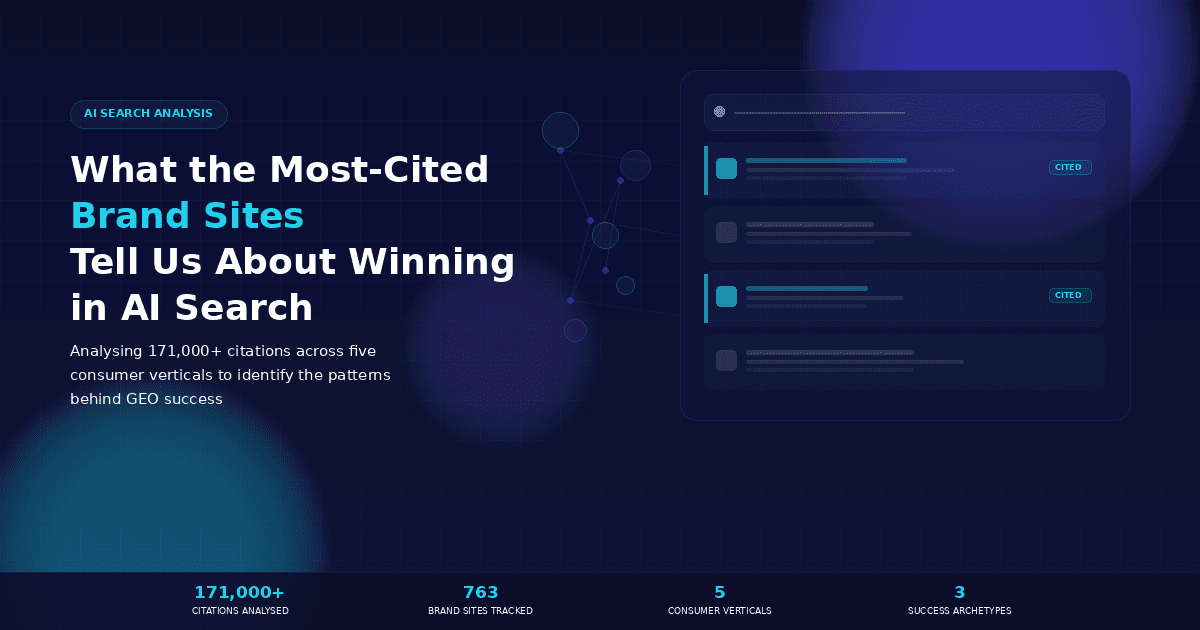
I analysed over 171,000 AI search citations across five consumer verticals - Automotive, Dining, Finance, Travel, and Wellness - to find out which brand sites get cited, why, and what marketers can do to have their content noticed and cited by AI Search. Of the nearly 2,000 unique domains analysed, over 750 were Brand or Commercial sites, with these generating almost 33,000 citations between them. The distribution is wildly uneven though with the top 40 brand sites accounting for 27% of all brand citations.
In this analysis I took a look at each of these 40 winners, using our own citation data from Obsero's platform to profile each site, then I ran a qualitative analysis of their content, trust signals, and authority structures to identify what makes them successful in GEO.
From this analysis three archetypes emerged with seven patterns that drove brand citations. Read on to learn more, and to find out how you can use this insight to get your brand's site noticed by AI Search.
Three brand archetypes
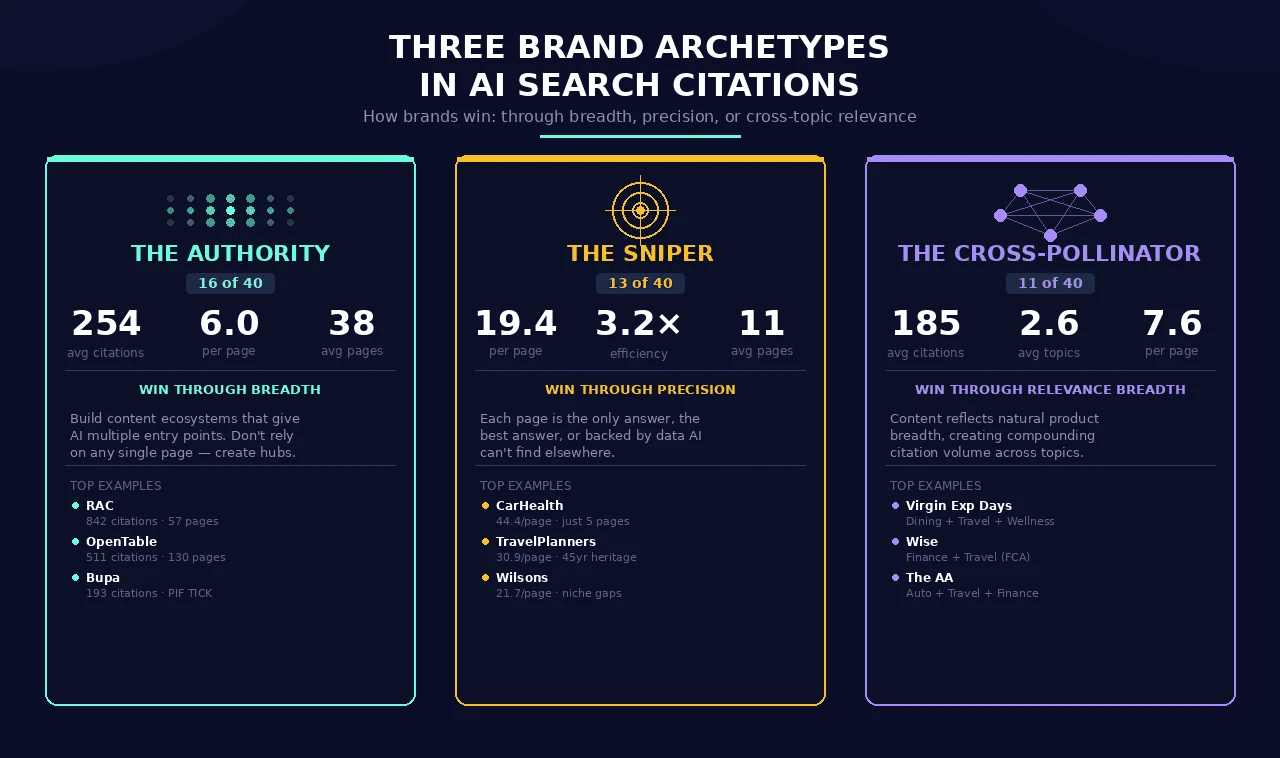
When I mapped citation volume against page count and content approach, three distinct archetypes emerged.
The Authority (16 of 40). These brands win through sheer breadth of content. RAC leads the entire dataset with 842 citations across 57 pages with its "Drive" content hub covers everything from buying guides to MOT advice to emissions standards. OpenTable publishes annually updated "Top 100" restaurant lists backed by almost 1 million verified diner reviews. Bupa has built a library of 480+ wellbeing articles with PIF TICK certification. IG runs a full trading academy and has over 15,000 pages on each language site. Authorities average 254 citations each but at lower efficiency (6.0 per page). They don't rely on any single page but instead build content ecosystems that give AI multiple entry points.
The Sniper (13 of 40). These brands win big with minimal content. CarHealth generates 44.4 citations per page from just 5 pages by synthesising official DVLA and MOT data into vehicle history reports. TravelPlanners earns 30.9 citations per page from 7 pages, relying on 45+ years of heritage and ATOL/ABTA credentials rather than content volume. Wilsons, a regional car dealership, punches well above its weight by filling niche knowledge gaps like Motability scheme guides that barely anyone else covers. Snipers average 19.4 citations per page — over 3x the efficiency of Authorities. Each page is either the only answer, the best answer, or backed by data AI can't find elsewhere. Hyper-personalised content which matches the context behind a user's prompt allow Snipers to win a share of citations that their content volume just doesn't justify.
The Cross-Pollinator (11 of 40). These brands are cited across multiple topics. Virgin Experience Days appears in Dining, Travel, and Wellness. Wise bridges Finance and Travel through fee transparency tools. The AA's 120-year motoring heritage gives it authority across Automotive, Travel, and Finance. WeCovr spans Automotive and Wellness through insurance comparison content. Cross-pollinators don't try to own one topic, their content reflects the natural breadth of their product, creating compounding citation volume.
Seven patterns that drive brand citations
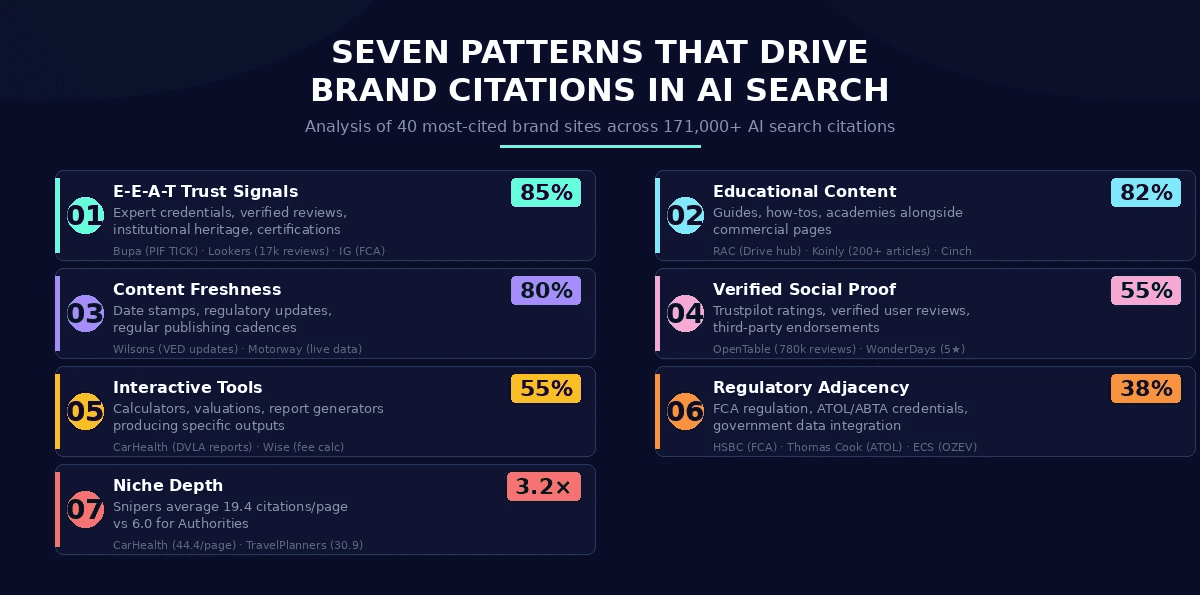
Through analysing the content of each of the top 40 most cited brand sites, I identified seven clear patterns:
1. Educational content alongside commercial pages (82%). Thirty-three of the 40 most-cited brands publish substantial educational content — guides, how-tos, academies — alongside their commercial pages. RAC teaches before selling insurance. Cinch explains car finance before listing inventory. QuantVPS publishes algorithmic trading tutorials that naturally lead to their hosting product. Koinly has 200+ articles explaining crypto tax across jurisdictions. AI needs to cite sources that explain, not just sell. Brands that educate earn the right to be cited.
2. E-E-A-T trust signals (85%). The strongest single predictor. Thirty-four of 40 brands display clear expertise, experience, authority, or trust signals. This ranges from institutional heritage (The AA's 120 years, Thomas Cook's 150+) to expert credentials (Bupa's PIF TICK certification) to verified review volume (Lookers' 17,000+ Trustpilot reviews with a 98% response rate, Cinch's 25,000+). These are the signals that help AI distinguish a trustworthy source from a generic one.
3. Content freshness (80%). Thirty-two brands signal ongoing currency through date stamps, regulatory updates, or regular publishing cadences. Wilsons publishes when VED road tax rules change. Motorway updates valuations with live market data. Shearings launches 27 new tour pages per year. For AI, recency is a proxy for accuracy which is why more than 50% of cited pages are less than 4 weeks old.
4. Verified social proof (55%). Twenty-two brands have significant review presence through Trustpilot, verified user reviews, or third-party endorsements including Defaqto. This includes OpenTable's 780,000+ verified diner reviews and WonderDays' 5-star rating with 99% positive reviews. For certain queries, AI trusts crowdsourced assessment signals as much as on-site content.
5. Interactive tools and calculators (55%). Twenty-two brands offer tools that directly answer questions. CarHealth's vehicle history reports. Wise's fee calculators. Motorway's AI-powered valuations. WeCovr's FIRE calculator. Tools are citation magnets because they produce specific, verifiable outputs rather than general commentary.
6. Regulatory and government adjacency (38%). Fifteen brands leverage proximity to regulatory bodies. For Finance brands there's FCA regulation (Wise, HSBC, IG, CarPlus, Bupa), in Travel ATOL/ABTA credentials (Thomas Cook, TravelPlanners, Home & Away), and across the board government data integration offers a way to build credibility (Electric Car Scheme with OZEV, CarHealth with DVLA). Regulatory adjacency is verifiable, hard to replicate, and is heavily weighted by AI.
7. Niche depth beats broad coverage for efficiency. Snipers average 19.4 citations per page versus 6.0 for Authorities, a 3.2x difference. CarHealth's 5 pages generate more citations per page than IG's 61. This doesn't mean breadth is wrong, RAC's 842 total citations dwarf any Sniper's total, but for brands with limited content resources going narrow and deep is a dramatically more efficient path.
What this means for brands and marketers
The brands winning in AI search aren't doing anything radical. They're doing something specific: building content that deserves to be cited.
If you have resources for breadth, build an Authority strategy. Create content ecosystems covering the full customer journey. Invest in review volume, educational hubs, and earned media. RAC, OpenTable, IG and Bupa are perfect examples of this.
If you have limited resources, build a Sniper strategy. Identify the 5-10 questions your brand can answer better than anyone and lean on unique data, regulatory expertise, or specialist knowledge to build unquestionable authority in answering these questions. Wilsons, Thomas Cook and Bumper.co are your models.
If your brand naturally spans categories, build a Cross-Pollinator strategy. Let your content reflect that breadth. Virgin Experience Days, Wise, and The AA show how multi-topic relevance compounds citation volume.
Whichever path you choose, the foundation is the same: build trust signals AI can verify (85% of the top 40 have them), teach rather than just sell (82% publish educational content), keep your content fresh (80% signal currency), and if you have regulatory credentials, make them prominent.
How to understand who's winning in your category?
This analysis is based on 5,000 generic, commercial prompts for 5 industry verticals. If you're a marketer who owns the content strategy for your brand then you need to start by understanding how your site is cited today, who's winning in your category and why, and formulate a plan from there.
Obsero's platform provides the visibility, sentiment and citation data which allows you to do just that, our AI agents allow you to automate the creation of GEO-optimised content regardless of the archetype you're closest to, and our team of consultants are on hand to partner with you to accelerate organic growth through AI Search. Get in touch today to learn more!
Growth through intelligence
Capture your brand’s historic visibility, recommendation and sentiment data from AI Search in one intuitive platform