
Back to Insight
Research
AI Search and Finance: which sites are really shaping the answers your customers see?

Mike Logue
SUMMARY
Deep dive into almost 60,000 citations across finance-related ChatGPT prompts in the UK. Comparison and aggregator sites dominate with 34% of all citations — nearly 3x their non-finance share. Covers banking, mortgages, investing, trading and crypto, revealing that challenger brands like Wise outperform HSBC, and 84% of finance domains appear in only one sub-topic.
AI Search and Finance - why I care
In my first blog I shared a cross-category analysis of almost 200,000 AI Search citations from ChatGPT in the UK. The headline finding was that niche and specialist publishers, together with brand sites, accounted for half of all citations. This far outweighed traditional media which dominates most businesses' PR plans.
But I also made the point that consistency across verticals is non-existent. The citation landscape looks completely different depending on whether you're in automotive, travel, dining, wellness or finance. So today I'm going to go deep on finance, partly because it's where I spent the first 15 years of my career but also because it's where we've seen some of the most striking and actionable patterns in our data.
For this piece I looked at almost 60,000 citations across thousands of AI answers from finance-related ChatGPT prompts in the UK in January and February 2026. Every prompt was commercial in intent, with no brand or product names mentioned. These are people asking things like "what's the best account for a first-time saver" or "which crypto exchange has the lowest fees in the UK" - in-market users who are ready to be guided to a product or service.
I split these prompts across five sub-topics: banking, mortgages, investing, trading and crypto. And the differences between them were far more dramatic than I expected.
The headline: comparison and aggregator sites dominate finance in AI Search
In a sector where products are commoditised, price sensitivity is high and where sky-high affiliate CPAs have resulted in a plethora of listicles, it's perhaps unsurprising to see comparison and aggregator sites dominate the finance citation list. Across the five finance sub-topics, comparison and aggregator sites accounted for:
34% of all citations, almost 3 times the share of citations for the non-finance topics I summarised in my previous article (12.4%)
Specialist publishers followed at 21%
Traditional news media at 16%
Blog and independent content at 13%
Brand sites at 12%
This tells us something important about how LLMs handle finance. When a user asks an agent a question about ISAs, mortgage rates or trading platforms, the model leans heavily on sites that compare and rank products — sites like TheInvestorsCentre, InvestPlatforms, CompareTheMarket and Finder. These are the sites building the narrative around your products in AI Search, and they're doing it with fewer domains but far greater citation density than any other site type.
But not all finance is created equal.
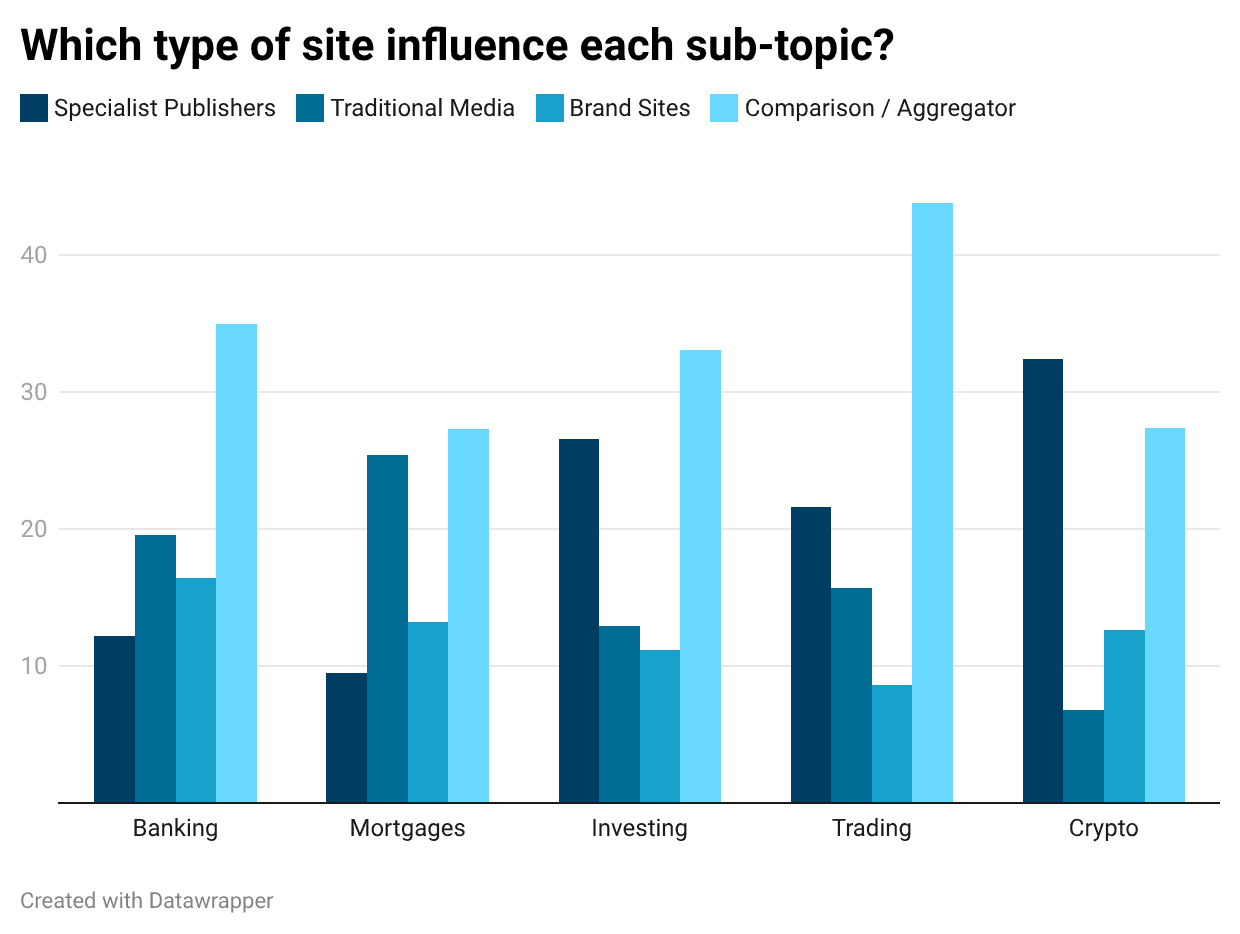
The aggregate numbers are interesting, but the real insight is in how dramatically the citation landscape shifts between sub-topics. Here's what I found.
Comparison sites punch above their weight
Just 94 unique domains are classified as comparison or aggregator sites but they average 190 citations per domain — higher than the 175 average for mainstream media, 147 for blogs and 137 average for specialist publishers. And this means that for four of the five sub-topics we track, comparison sites are the most influential category in shaping AI answers.
This matters for brands because comparison sites are places where your product positioning is directly visible to users and now to agents and LLMs. If a comparison site ranks you poorly or doesn't list you at all, that absence or negative positioning is being fed directly into AI Search answers. And it's not just the highest-traffic comparison sites which are driving AI answers. Your affiliate team might need to broaden their horizons…
Crypto is the exception to this rule
Crypto has effectively built its own information ecosystem that LLMs trust. Sites like CoinBureau, Investing.com and Koinly are the authorities that ChatGPT turns to, not Forbes, nor The Guardian. In fact, Forbes accounts for just 0.6% of crypto citations, compared with 15% in mortgages.
Reddit also tells an interesting story here. Across all of finance Reddit's citation share is modest, but in crypto it picks up 286 citations — roughly three times its presence in banking and six times its presence in mortgages. For crypto brands, community-driven content clearly matters more to LLMs than it does elsewhere.
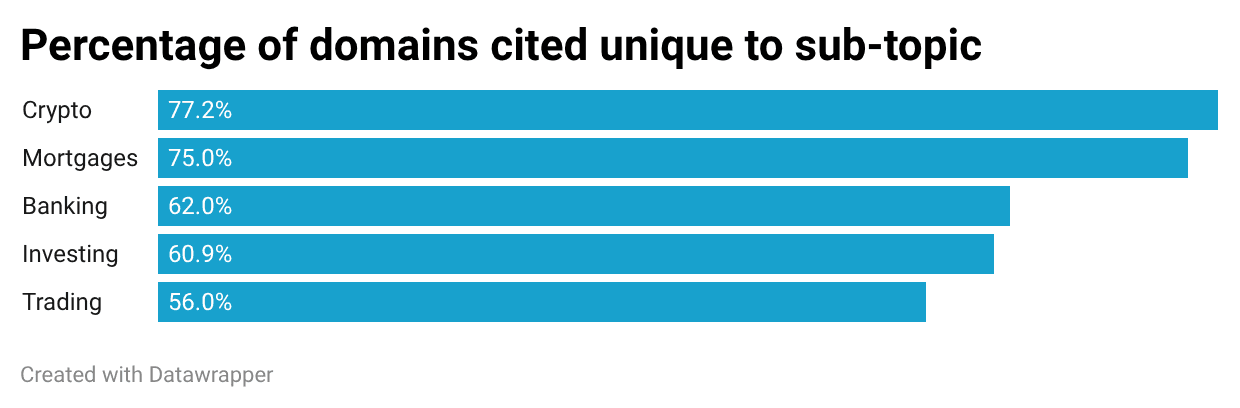
And crypto had the most unique citation sources of any sub-topic, with 376 domains appearing only in crypto and nowhere else in finance — 77% of all crypto domains. This is a genuinely distinct ecosystem.
Investing and trading: where comparison sites lead and specialists follow
Investing and trading both show a clear hierarchy: comparison and aggregator sites lead, followed by specialist publishers. In trading, comparison sites account for 44% of classified citations, with specialists at 22%. In investing, comparison sites take 33%, with specialists at 27%.
In investing, the comparison landscape is concentrated. InvestPlatforms.co.uk leads with 1,166 citations, followed by Koody at 622 and TheInvestorsCentre at 492. On the specialist side, MoneyWeek leads at 551 and BritWealth at 400.
Trading, by contrast, has the most dispersed specialist citation pattern. The top five specialists account for 62% of specialist citations. Sites like Sterling Savvy, PsyFitec, UK Investing, DayTrading.com and MoneyWeek all contribute meaningfully.
For brands in the trading space, this dispersal is actually good news. It means there are more specialist publications influencing AI answers, and therefore more opportunities to shape the narrative through content partnerships and PR.
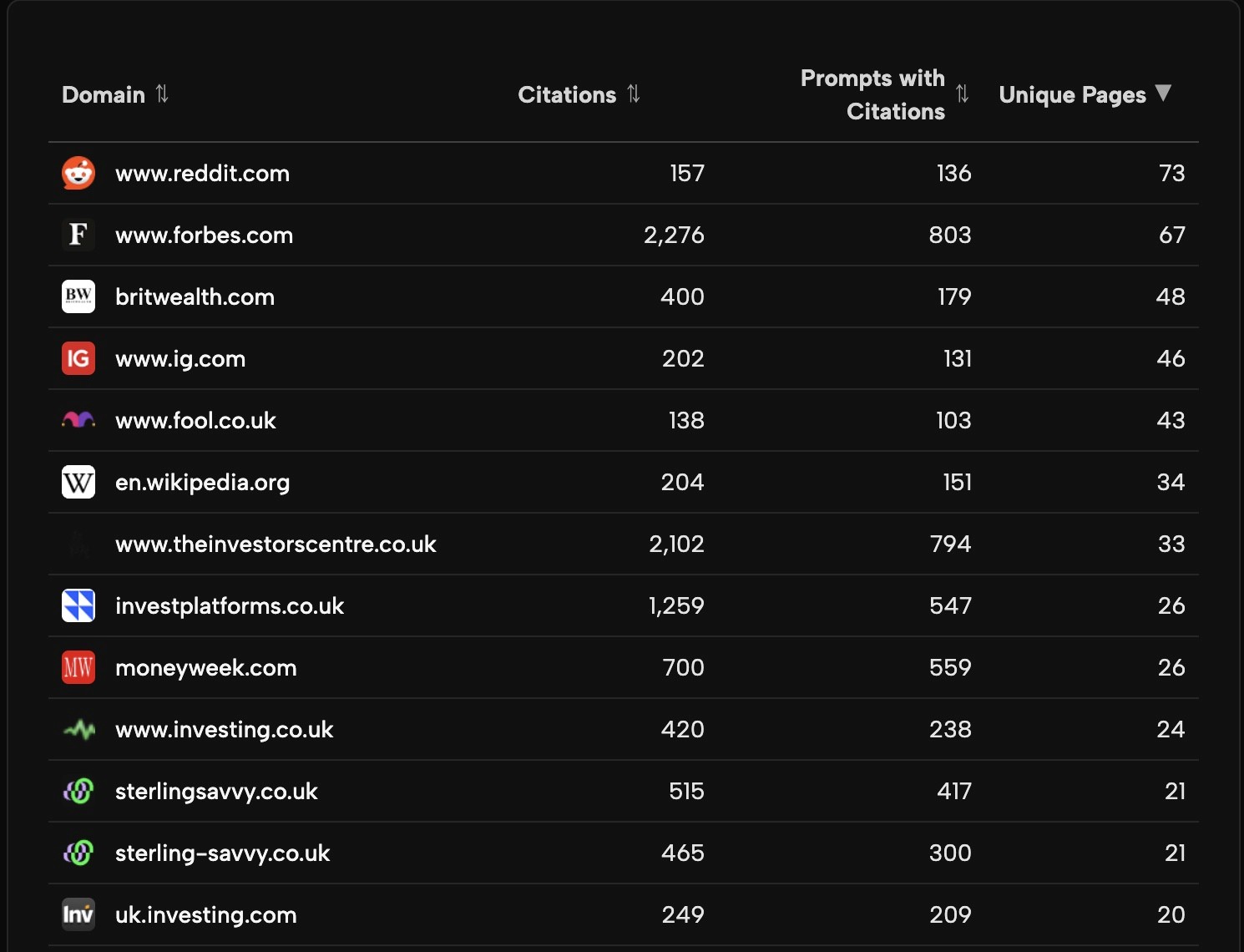
The websites which are most influential aren't necessarily those with a plethora of pages covering different topics however. In the table below from Obsero's platform you can see that theinvestorscentre.co.uk is cited over 2100 times across just 33 pages. Compare that to www.fool.co.uk who have more of their pages cited (43) but are only cited 140 times. The quality and context of content is as important as the quantity.
Banking: proof that smaller brands have a shot
Banking is the sub-topic where brand sites have the highest share of citations at 16%. Wise leads with 496 citations, followed by HSBC at 266 and Raisin at 231.
What's notable is that Wise - a true challenger brand - is being cited almost twice as often as HSBC, one of the UK's largest banks. Raisin, another challenger, is in third place. In AI Search, brand heritage counts for less than content quality and relevance when choosing which content to surface.
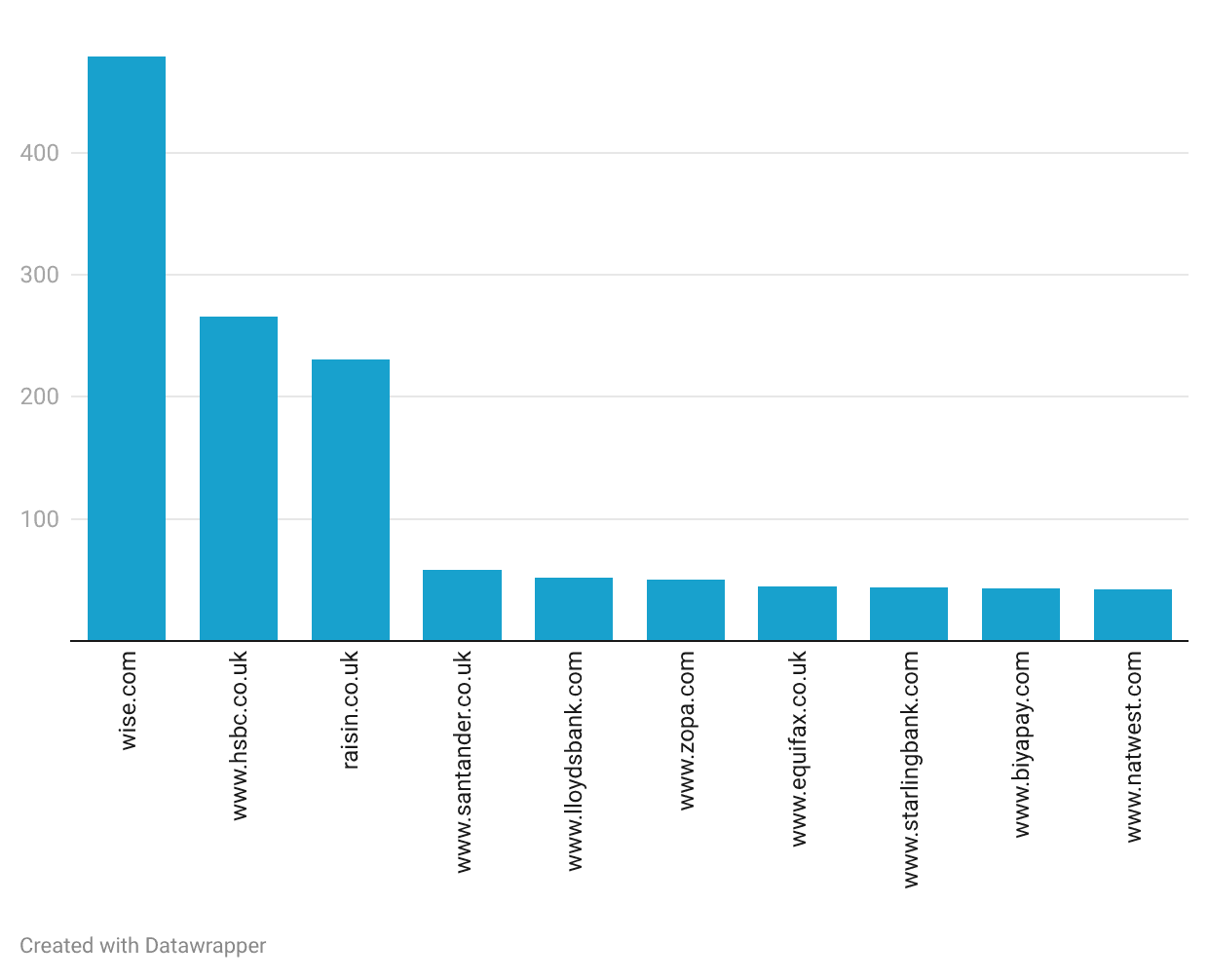
But to emphasise the importance of third party content in driving AI answers, the correlation between these brand site citations and who actually shows up where in AI answers is weak. Your own content will be used for fact checking and to shape the narrative around your brand, and so being cited is important, but the algorithm will always lean to independent highly contextual content when creating recommendations.
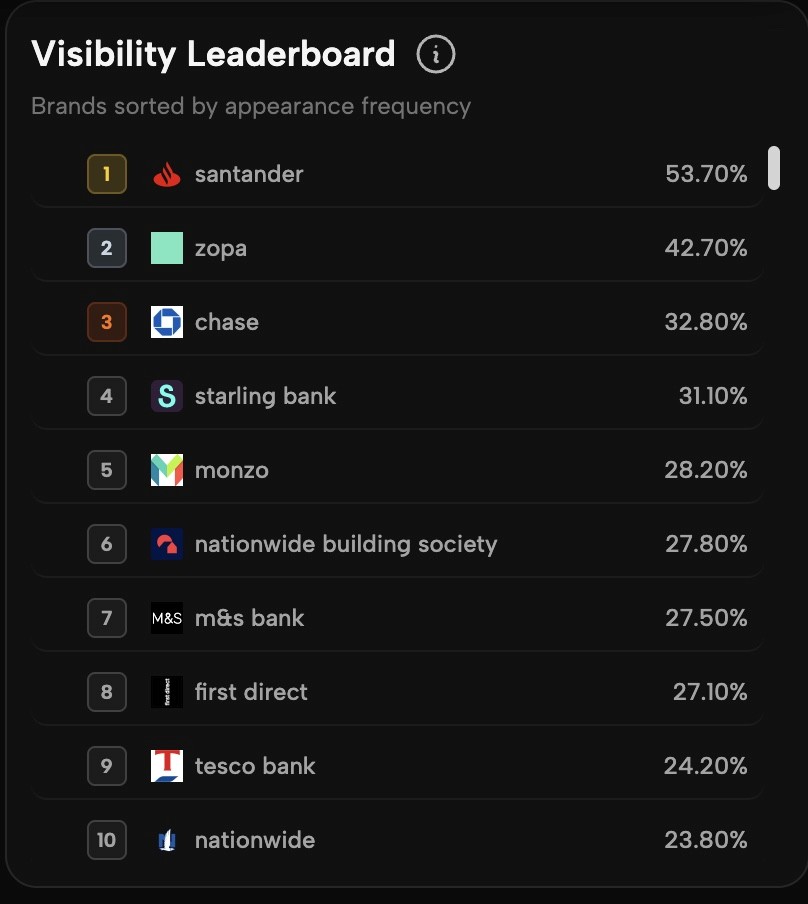
Zopa, Chase, Starling and Monzo, all challengers in the UK and all outside of the top 5 most cited banking brands, occupy 4 of the 5 top spots in the visibility leaderboard for our banking topic. Zopa, appearing at position 2 on visibility and position 6 on citation source (and an Obsero customer!) arguably winning the AI Search race in this topic.
The long tail matters even more in finance
Only 16 domains of the 1,850 domains we captured appear across all five finance sub-topics. The most broadly cited are Forbes, MoneytotheMasses, MoneyWeek and Finder, sites with wide enough editorial scope to cover everything from crypto to mortgages.
But 1,553 domains — 84% of all finance domains in our data — appear in only one sub-topic. This reinforces the message from my first blog: the long tail of specialist, category-specific content is where the real influence lies. A crypto brand and a mortgage brand are operating in almost entirely different citation ecosystems, and their AI Search strategies need to reflect that.
What does this mean for finance marketers?
Three things stand out:
Your PR strategy for AI Search should be led by your niche. A banking brand benefits from traditional media coverage far more than a crypto brand does. A trading brand should be thinking about the diversity of specialist publishers in its space, while a mortgage brand needs to consider the outsized influence of a single domain like Forbes.
Comparison and aggregator sites deserve more attention than they typically get. They're few in number but disproportionately powerful in AI Search. How your brand appears on theinvestorscentre.co.uk, CompareTheMarket or Which? directly shapes how LLMs describe your product.
Challenger brands can win and are winning. Wise is outperforming HSBC. Niche publishers that didn't exist five years ago are outperforming The Financial Times and Forbes. AI Search rewards relevance and depth over brand heritage. That's a genuine opportunity for any finance brand willing to invest in the right content strategy.
But even as I work down from an overall view of citation analysis, to the Finance topic and further into sub-topics within Finance, this analysis is still too generalist for brands to get real value from. Real value, instead, comes from understanding exactly which content, which publishers, which pages, which competitors are relevant for the conversations your customers are having with AI Search.
Obsero's citation analysis provides you with the depth of insight you need to know which domains and pages dominate your category, which are emerging and entering the conversation as the LLMs' algorithms evolve, and the pages and publishers which are increasing or decreasing in importance over time.
Get in touch today for a demo and to understand how our platform can help drive growth through AI Search.
Growth through intelligence
Capture your brand’s historic visibility, recommendation and sentiment data from AI Search in one intuitive platform
Table of Contents